Media & Press Kit
Complete press resources for journalists, podcast hosts, reviewers, and event organizers covering Project Symphony and organizational workflow orchestration.
About Project Symphony
Project Symphony is not a methodology book. It is a practical guide to orchestrating work across people, teams, and systems so that execution becomes predictable, sustainable, and aligned with real organizational constraints.
Rather than prescribing specific frameworks, Project Symphony focuses on how work actually flows through teams, handoffs, tools, dependencies, and decision points, and how leaders can intentionally design that flow. Methodologies are treated as instruments, not the music itself.
The book equips leaders and practitioners to design clear work centers with defined responsibilities, align strategy with execution, reduce friction from mismatched processes, and create systems that scale without constant heroics.
Brand Assets & Downloads
High-Resolution Images



Brand Guidelines
- Primary Colors: Navy Blue (#0E2D42), Steel Blue (#577589)
- Typography: Professional, clean sans-serif
- Logo Usage: Available upon request
Need alternate formats, custom sizes, or additional assets? Contact us directly.
Quick Facts & Statistics
Book Overview
Title
Project Symphony: Orchestrating Work, Alignment & Execution
Author
Joshua Williams
Format
Softcover
Target Audience
Technology leaders, engineering managers, organizational architects
Primary Focus
Workflow orchestration and organizational alignment across 6 comprehensive sections
Author Credentials
Experience
20+ years in technology leadership
Leadership Scope
Director‑level engineering leadership
Platform Expertise
Web, API, Desktop, Mobile, Embedded
Impact Scale
Systems used by hundreds of thousands
Specialization
Cross‑functional team orchestration and software delivery optimization
Author Bio
Joshua Williams is a technology leader and systems thinker with over two decades of experience building scalable software platforms with high‑performing teams.
Joshua is passionate about helping teams work in sync, removing the friction that comes from silos, unclear priorities, and broken handoffs. His approach combines systems thinking and technical leadership to make execution more predictable and teams more effective.
Interview Topics & Speaking Angles
Organizational Orchestration
The Orchestra Analogy and Organizational Conductors
Why most organizations operate like musicians without a conductor, creating chaos instead of harmony. (Chapter 1: "The Symphony")
Why Methodologies Need Orchestration
Each methodology is like an instrument—powerful individually but requiring coordination to create harmony. (Chapter 3: "The Methodologies")
Breaking Silos Without Reorganizing the Company
Practical ways to fix cross-team handoffs, ownership gaps, and dependency friction. (Chapter 1: "The Musical Sections")
Busy vs. Effective: Why Work Slows Down
How organizations get stuck in motion without progress—and how to restore momentum. (Chapter 6: "Embracing System Thinking")
Systems & Implementation
Identifying and Exploiting Bottlenecks
The water hose analogy: how the weakest link limits your entire system's performance. (Chapter 3: "Theory of Constraints")
Designing Work Centers That Actually Work
Moving from ambiguous team responsibilities to clear, measurable work centers with defined purpose. (Chapter 4: "Define Work Center Purpose")
Predictable Delivery Without Heroics
How to build execution systems that don't rely on burnout, overtime, or "go-to" individuals. (Chapter 4: "Workflows and Processes")
The First 30 Days of Change
Quick wins that demonstrate value without disrupting existing workflows. (Chapter 6: Field Guide)
Sample Interview Questions
Foundation & Purpose
- What organizational problems inspired Project Symphony?
- How does the orchestration metaphor translate to other industries?
- What makes this approach different from existing methodologies or frameworks?
- Who is the primary audience for this methodology?
Implementation & Practice
- How can leaders identify workflow bottlenecks in their organization?
- What does a well‑designed work center look like in practice?
- How do you measure the success of organizational orchestration?
- What are the most common workflow coordination challenges?
Quick Wins & Results
- What quick wins can leaders expect in the first 30 days?
- How do you improve coordination without disrupting existing workflows?
- Can you share a specific example of workflow dissonance and its resolution?
- What role does leadership play in successful orchestration?
Strategy & Execution
- How does this approach align with current engineering trends?
- What's the future of organizational design in technology companies?
- How can smaller teams apply these principles without formal processes?
- What advice would you give to leaders struggling with cross‑team coordination?
Complementary Resources & Tools
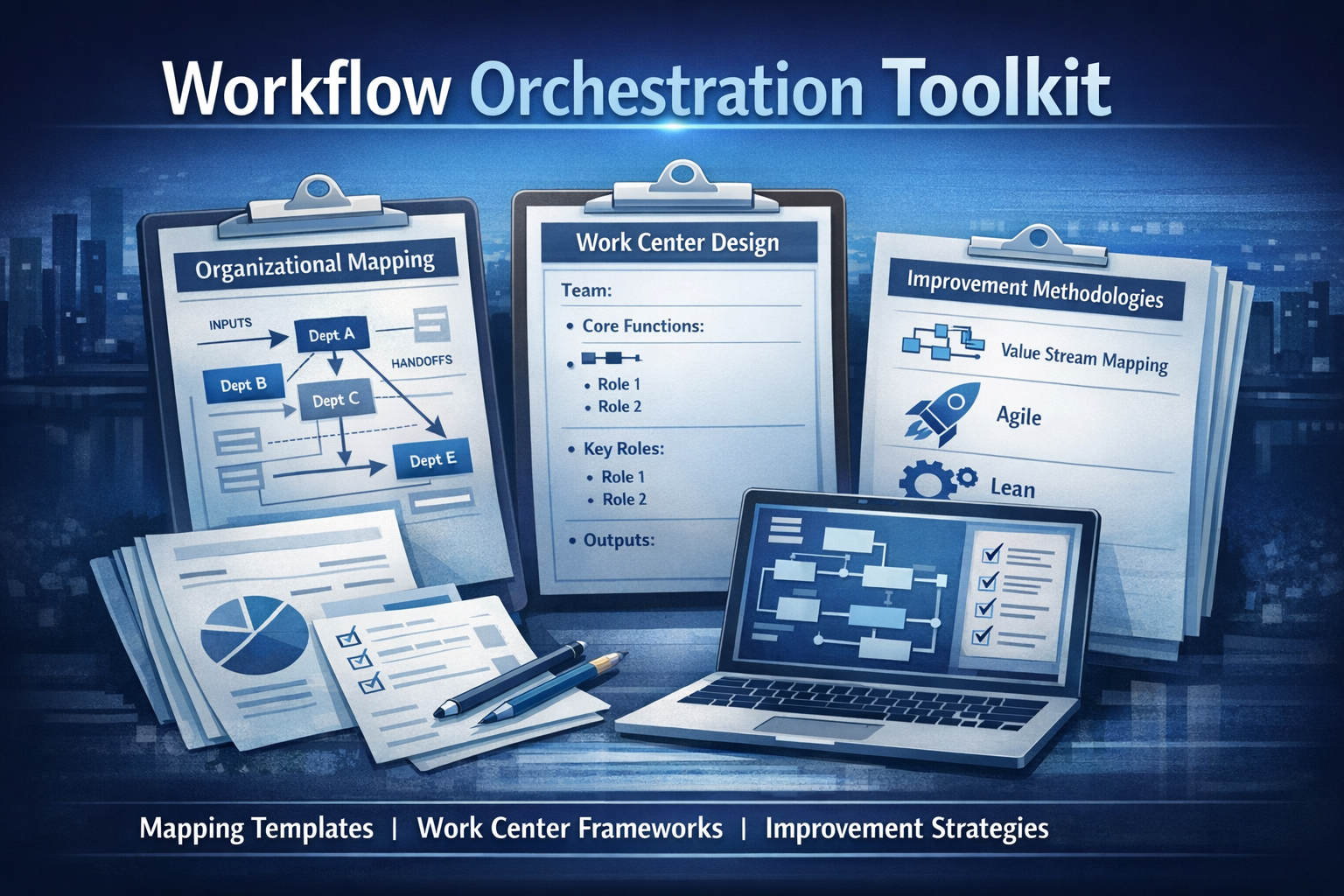
Workflow Orchestration Toolkit
Comprehensive collection of templates and worksheets including organizational mapping, work center design, methodology selection frameworks, and continuous improvement practices.
Formats: Word Doc, PDF | Use: Workshop facilitation, team assessment
Access ToolkitExecutive Alignment Deck
Complete presentation package with slides, presenter's guide, executive summary, and follow‑up templates. Designed for 15‑minute leadership briefings.
Formats: PowerPoint, Word, PDF | Use: Leadership presentations, stakeholder alignment
Download DeckKey Concepts & Glossary
Work Center
Focused operational unit with clear purpose and measurable outcomes
Orchestration
Deliberate coordination of methodologies for optimal flow
Constraint
Limiting factor capping system throughput and performance
Flow
Smooth progression of valuable work through organizational systems
Media Inquiries & Speaking Requests
Available for interviews, podcast appearances, conference speaking, and workshop facilitation. Response time: 24‑48 hours for media inquiries.
Direct Contact: hello@project-symphony.com | Professional: LinkedIn Profile | Detailed Inquiry: Contact Form