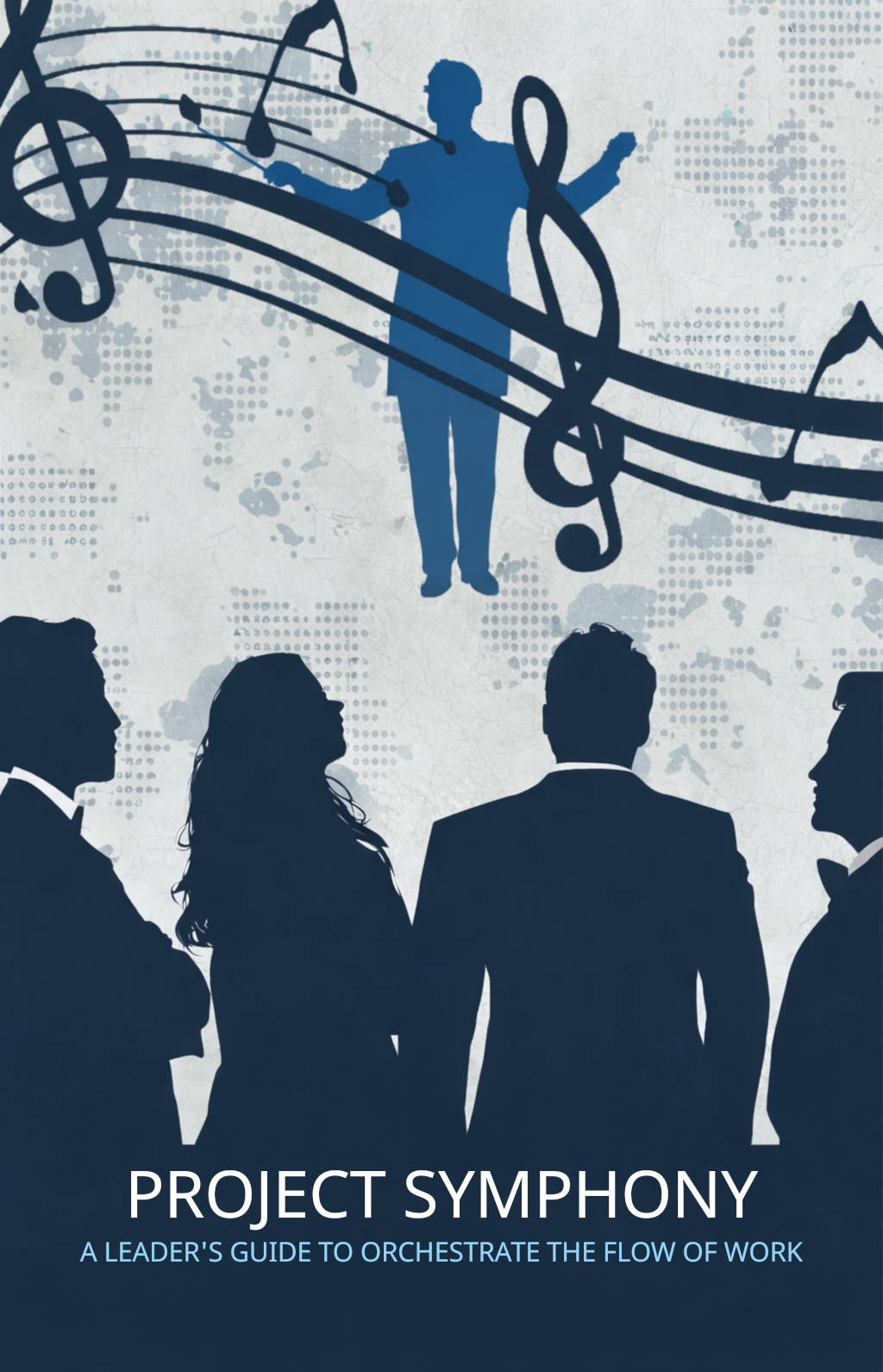
Project Symphony
A practical guide to seeing how work actually moves, fixing the real blocker sooner, and orchestrating teams around constraints without piling on meetings.
Inside you'll map how work flows today, spot delays early, use simple shared terms so teams stop talking past each other, blend only the practices that help, and run small improvement experiments that make delivery steadier.
Softcover available now. Toolkit worksheets are included; deeper facilitation scripts live in the Field Guide.
Who It's For
- Executives and PMO leaders who need strategy and delivery working in sync.
- Engineering & DevOps managers tired of release headaches and hidden bottlenecks.
- Product and platform leads balancing roadmap progress with reliability.
- Improvement coaches who want Lean and Agile to play nicely together, without more meetings.
What You'll Learn
- Map Work Centers and value streams to identify the real constraint early (Ch 4).
- Use existing practices as instruments in your orchestrated approach, avoiding ceremony bloat (Ch 3).
- Design sustainable cadences that connect strategy, delivery, and learning rhythms (Ch 2).
- Run constraint-focused improvement experiments using Field Guide templates (Ch 6).
Inside the Book
Book Excerpt
"Suppose an orchestra begins at each musician's discretion, ambitious to play their favorite and finest piece without a well-defined score, the conductor's guidance, or an awareness of what their fellow musicians next to them will do. Chaos will surely ensue as each musician plays their instrument without synchronization, resulting in a cacophony of dissonance. Even though each musician is an expert at what they do on their own, without a clear plan, each musician plays at their own pace and volume, leading to confusion, frustration, and an unrecognizable melody.
Picture the same orchestra with a skilled conductor and a meticulously prepared musical score. The conductor's baton signals the beginning, and the orchestra plays harmoniously. Each movement of his baton sets in motion the vision he has communicated and has been rehearsed by the musicians as he guides the tempo, providing the queues necessary for each section and instrument to either begin their next step or a graceful exit as their part fades to a conclusion. The conductor shapes the dynamics, signaling volume, intensity, and mood changes. This prepared conductor maintains the rhythm through complex passages of the performance, as he knows each instrument's role and the precise moment to guide each piece into the composition. The result is a captivating symphony that resonates with the audience's emotions as they observe the intentional expression of the interpretation and note the emotion and moments of emphasis. Each role is fluent in understanding and conveying the composition. At the same time, the audience observes the communication as it's acted out in real-time with a remarkable effect."
Consider this orchestra analogy as a picture of your organization. The conductor represents leaders who need to understand the structure of your organization, its work centers, and how the work flows through it. Just as the conductor and such skilled artists use a musical score to ensure each musician plays their part at the right time, leaders and those skilled employees executing the work need a precise model of the organization's flow to synchronize their efforts. Leaders equipped with a well-defined model can conduct harmonious acts of collaboration that yield remarkable results to transform a disjointed collection of work centers into a beautiful symphony able to achieve exceptional outcomes, ensuring alignment, efficiency, and success for the entire organization.
From this foundation, the book guides you through transforming organizational chaos into coordinated flow:
Part I: Setting the Foundation
Chapters 1-2: Why teams create chaos without shared workflow • Designing sustainable cadences
Stop the endless cycle of competing priorities and missed handoffs. Learn why even expert teams struggle when everyone optimizes locally, and discover how to create rhythm that actually connects strategy to daily work without adding meetings.
Part II: Orchestrating Practices
Chapters 3-4: Blending methodologies without ceremony bloat • Designing constraint-aware Work Centers
Finally make Lean, Agile, DevOps, and TOC work together instead of against each other. Map your actual value stream to spot the real bottlenecks before they become firefights, and design Work Centers that optimize for flow instead of utilization.
Part III: Making It Stick
Chapters 5-6: Systematic change execution • Complete Field Guide with ready-to-use tools
Turn insights into lasting improvements with a proven implementation approach. The Field Guide provides templates, assessment surveys, and experiment frameworks you can use immediately, no consulting required.
What Leaders Are Saying
Testimonial
Every situation can be substantially improved; even the sky is not the limit.
Testimonial
Organizational change, like a symphony, takes time to harmonize completely through adjustments, fine-tuning, and ongoing communication.